The tradition
Zellige, zillij in Arabic and alicatado in Spain, from the Arabic for “the cut”, is mosaic made from glazed tiles of a single colour, cut by hand into small pieces and fitted together to a drawn design. In the Nasrid palaces of the Alhambra at Granada, panels of it in blues, greens, ochres, black and white line the lower walls, many built round eight-pointed stars. In Fez it is still cut by master craftsmen, the maalems.
The geometry
The stars come from girih, the strapwork of Islamic geometry. In 1925 E. H. Hankin showed how such patterns can be drawn: over a grid of polygons, lines leave the middle of every edge at one angle and run on until they meet. Craig S. Kaplan made the method precise in 2005, and in 2007 Peter Lu and Paul Steinhardt showed that the girih at the Darb-i Imam shrine in Isfahan (1453) come close to quasicrystalline order, centuries before mathematicians described it.
How we make yours
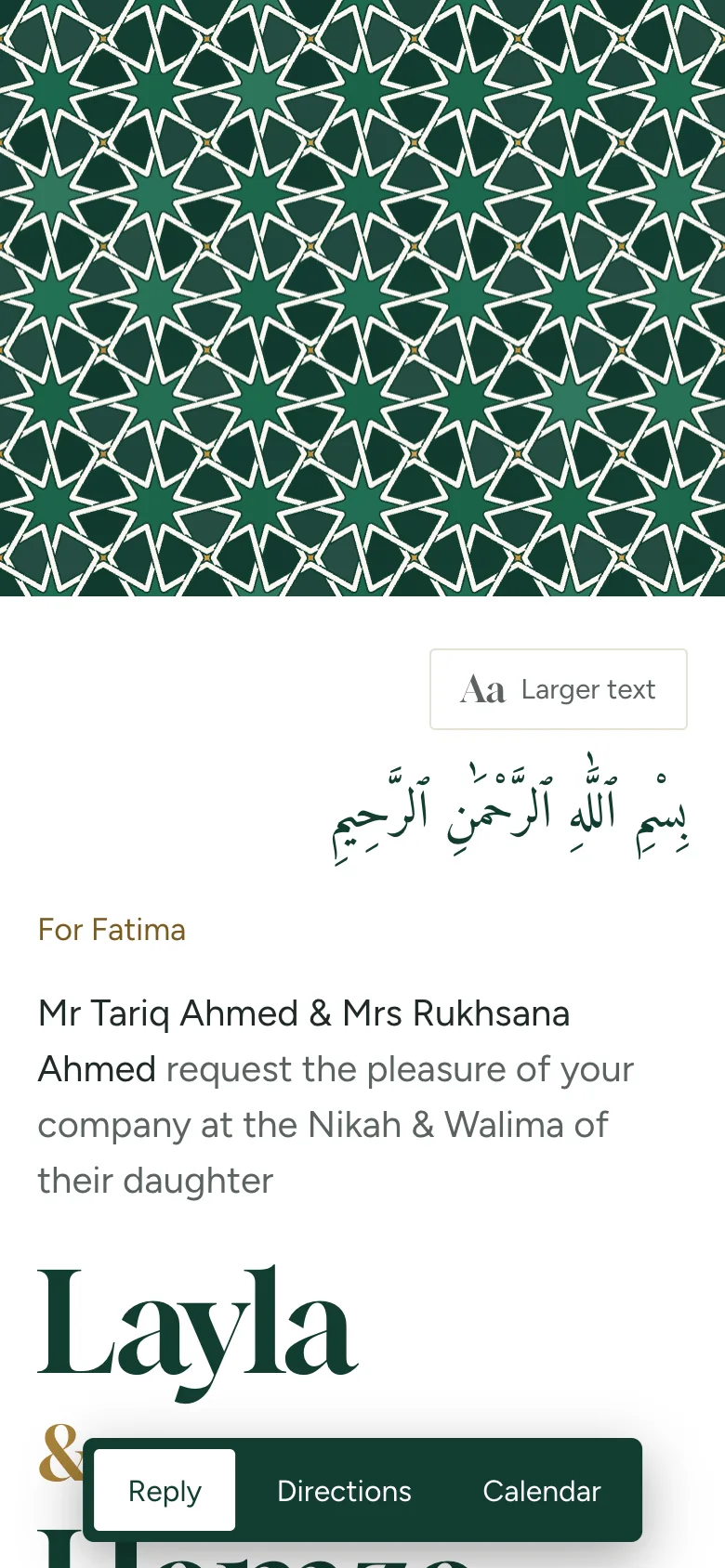
Your names choose one of six classic patterns, eight-pointed stars and crosses, sharp eight-pointed stars, two kinds of six-pointed stars, twelve-pointed rosettes and interlaced squares, or you choose it yourself. Najm draws it by Hankin’s method, joins its lines into bands that weave over and under at every crossing, as on the walls of the Alhambra, and glazes each shape between them in its own colour. As it opens you see it made: the construction lines, the stars, the tiles set outward from the middle, the bands woven through.
The colours
Each colourway is a set of glazes: deep and bright greens with honey gold for Malachite; cobalt, turquoise and gold for Lapis; and Rose, Marigold and Night for engagements, Mehndis and evenings, the strapwork in white or, at night, in gold.
The type
Your names are set in Gloock by the Portuguese designer Duarte Pinto, a high-contrast serif drawn from newspaper headlines; the rest in Figtree by Erik D. Kennedy, chosen for being easy to read on a phone; the Bismillah in Amiri.