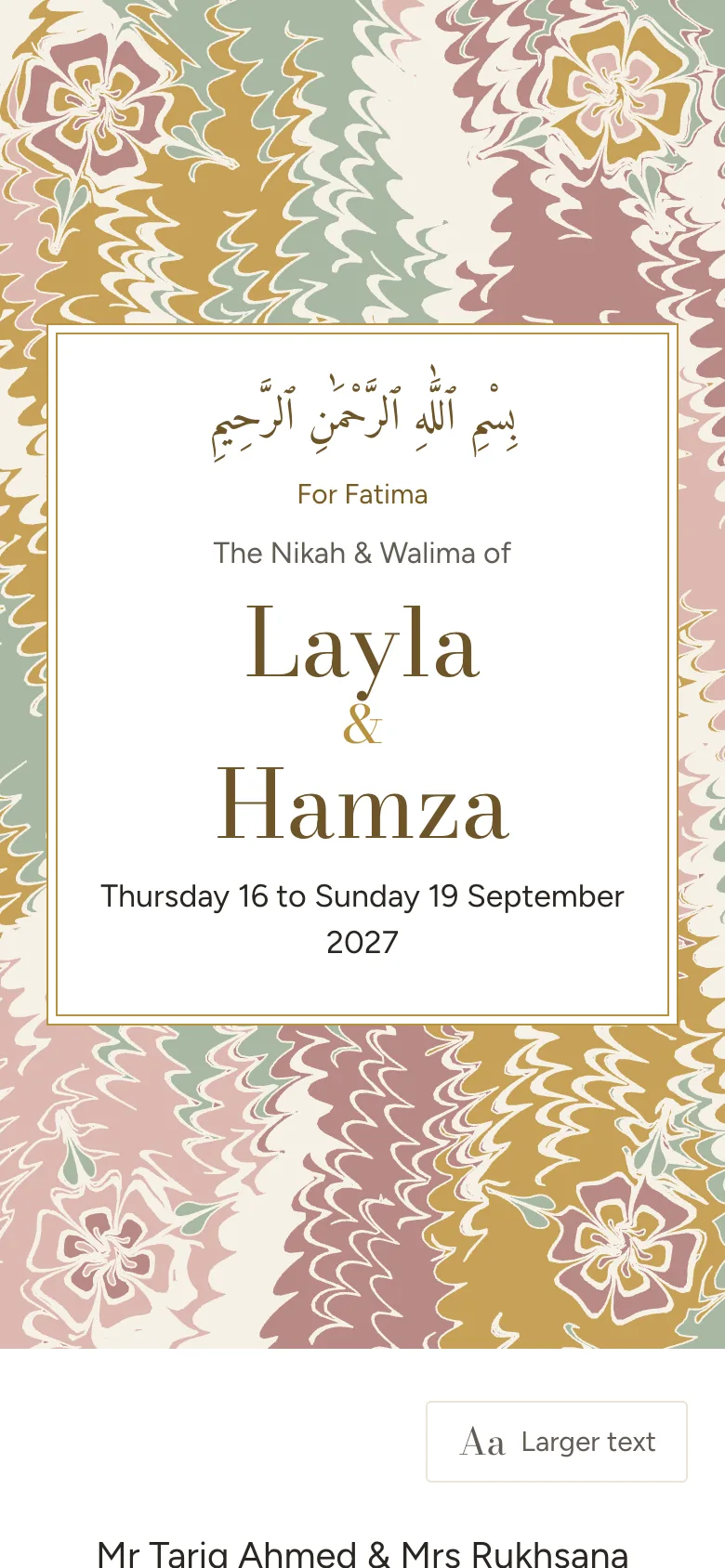
The tradition
Ebru is the Turkish art of making colourful patterns by sprinkling and brushing pigments onto a trough of thickened water, then laying paper on the water to lift the pattern. Each colour is mixed with a few drops of ox gall, which lets it float and keeps it from running into the colours beside it. In 2014 UNESCO inscribed it on the Representative List of the Intangible Cultural Heritage of Humanity.
Its masters
Hatip Mehmed Efendi (died 1773), preacher at Hagia Sophia, is credited with the flowers made by dropping rings of colour and drawing them into shape with a needle, still called hatip ebru, though some historians now question where they began. He died in a fire at his house in Sirkeci trying to save his work. In the twentieth century the calligrapher and imam Mehmed Necmeddin Okyay, born in Üsküdar in 1883, made flowered ebru his own and carried the art on.
How we make yours
Your ebru is made on your screen with the exact equations of marbling published by Shufang Lu, Aubrey Jaffer and colleagues: every drop pushes the inks already on the water outward, and every comb draws them along its teeth. About fifty drops are laid, combed down and back up between the first comb’s teeth (gel-git), drawn across with a fine comb (taraklı) and eased into a gentle wave. Then a flower is made in each corner as hatip flowers are: rings of colour dropped one inside another, drawn into petals with a needle toward their heart, and two leaves pulled to a point; the water flows round the needle’s tip so that no ink is gained or lost. Your names choose where every drop falls and the colours of the flowers, and each family’s own link is marbled for that family alone.
The colours
Ivory & gold, the colourway a wedding begins in, lays gold, blush and sage on an ivory bath; Powder blue, for a baby’s Aqiqah, is softer still. Iznik takes its inks from the pottery of İznik: cobalt blue from the late fifteenth century, turquoise by the 1520s, and the bright red made from a special clay that the potters added in the 1550s, when the Süleymaniye mosque was being built. Rose madder, Garden and Dusk are inks chosen to sit together on the water as they do in the trough.
The type
Your names are set in Bodoni Moda, Owen Earl’s redrawing for screens of the letters of Giambattista Bodoni (1740–1813), printer at Parma. The Bismillah is set in Amiri, Khaled Hosny’s revival of the naskh type of the Bulaq Press in Cairo.