The tradition
Bagh means garden. On the Taj Mahal, built by Shah Jahan at Agra for Mumtaz Mahal, flowers were inlaid in coloured stone into white marble, a technique called pietra dura in Florence and parchin kari in Mughal India, so that, in the words of the poet Kalim, they would stay in perpetual bloom. The historian Ebba Koch reads them as the flowers of the garden of Paradise.
The panels
Round the tomb chamber, carved panels show plants in flower growing from a small mound of earth, drawn with mirror symmetry. Koch found that one of them closely resembles an engraving by Claes Jansz, among the European prints that Jesuit missionaries brought to India: Mughal flowers grew from many gardens. Some of the Taj’s flowers can be named, tulips, poppies and lilies among them; others are plants of the imagination.
How we make yours
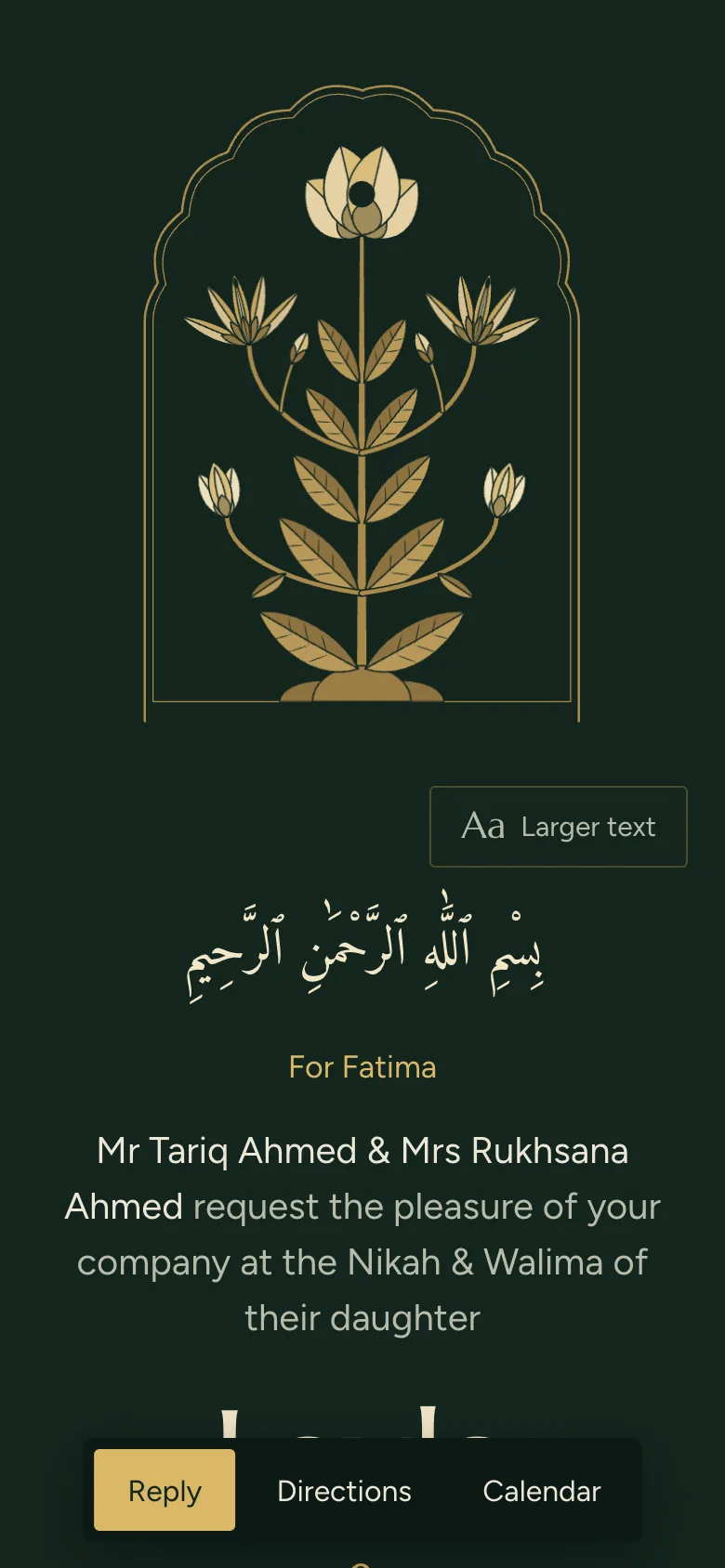
Your plant is grown by Najm from your names: a stem rising from its mound inside a double cusped arch, pairs of leaves smaller as it climbs, a pair of flowers on curving stalks high up with a bud beside each, a smaller pair of another kind lower down, and one flower at its head, tulip, poppy, lily, iris or carnation, all mirrored about the stem as the panels are. It is cut as inlay is: each petal from three tones of its colour, each leaf from two along its midrib, with a fine seam of the ground between every piece and the leaves’ veins. As it opens, the arch draws itself, the stem rises, the leaves unfurl and the flowers open piece by piece. It is drawn in flat colour, never as a picture of stone.
The colours
Gold on green and Gold on lapis lay the whole plant in gold on deep green or deep blue, as the gilder Harif laid gold flowering plants on an indigo ground around a portrait of Shah Jahan, signing his name twice, tiny, among the leaves. Marble sets it in the muted tones of the stones of pietra dura, carnelian, lapis, yellow jasper and jade, on white. Rose and Saffron are for engagements and Mehndis.
The type
Your names are set in Marcellus by Brian J. Bonislawsky of Astigmatic, a flared roman drawn from the letters cut in classical Roman inscriptions.